
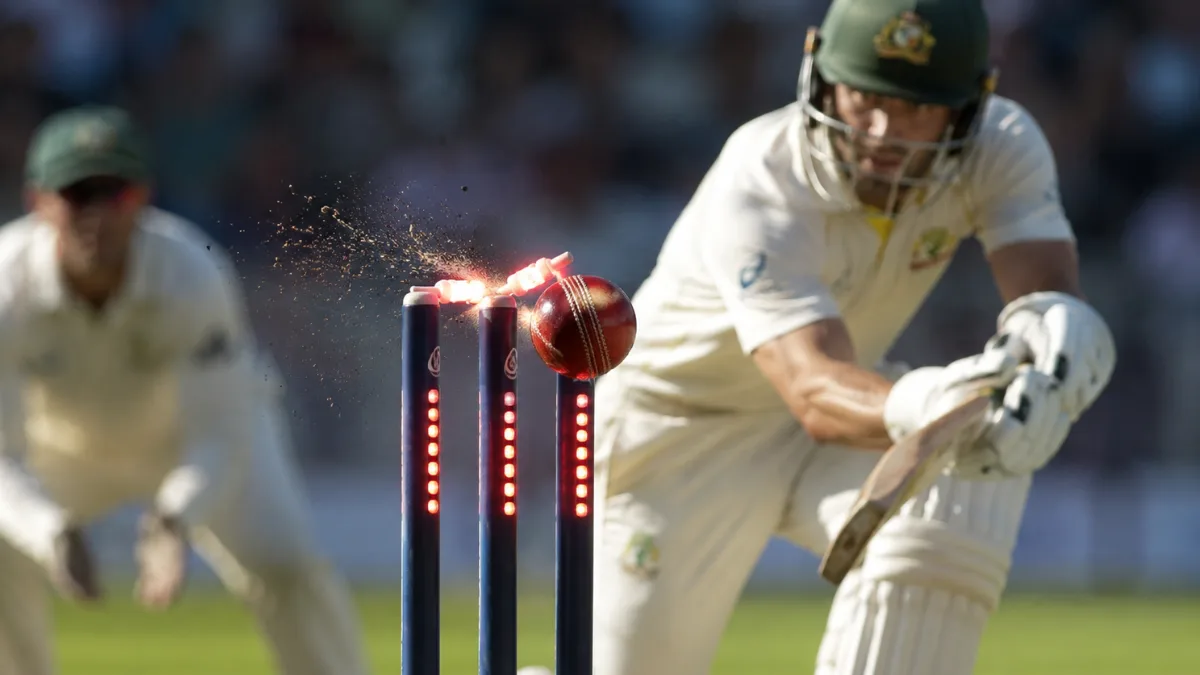

Does 50% of the ball have to hit the stumps in DRS? The “50% rule” is a common shortcut but current ICC playing conditions do not calculate or display an exact percentage. Ball tracking checks whether the centre of the projected ball is inside the defined Wicket Zone.
When part of the ball would hit the wicket but its centre remains outside that zone, DRS shows Umpire’s Call. The original on-field decision then remains unchanged.
This explanation assumes that the delivery also satisfies every other requirement for an LBW dismissal.
Is 50% of the Ball an Official DRS Measurement?
No. The official DRS protocol does not say that a computer must measure whether exactly 50% of the ball overlaps the stumps.
Under current ICC international playing conditions, ball tracking places the projected delivery into one of three categories:
| DRS result | What it means |
|---|---|
| Hitting | The ball would hit the wicket, and the centre of the ball is inside the Wicket Zone |
| Umpire’s Call | The ball would hit the wicket but the centre of the ball is outside the Wicket Zone |
| Missing | The ball would miss the wicket |
This centre-of-the-ball test explains why commentators often describe the rule as “more than half the ball.” If the centre crosses inside the outer boundary of the wicket, more than half of the ball will usually appear to overlap that boundary.
However, 50% remains an informal explanation rather than the official measurement used in the written protocol.
What Is the Wicket Zone in DRS?
The Wicket Zone is the area ball-tracking technology uses to decide whether the projected delivery would have hit the wicket strongly enough to receive a Hitting result.
Current ICC conditions define it as the actual outline of the complete wicket, from the base to the top of the stumps, including the parts of the bails that extend above the stumps.
The ICC introduced this updated definition in 2025. The Wicket Zone now follows the actual outline of the stumps and bails rather than relying on a more simplified representation of the wicket.
This change makes “50% of the ball” an even less precise way to describe the official rule. The decisive question is not how much of the ball appears to cover the wicket on television. The system checks whether the centre of the projected ball lies inside the Wicket Zone.
Why Can the Ball Touch the Stumps but Still Show Umpire’s Call?
A projected delivery can clip the outside of a stump or the top of a bail while the centre of the ball remains outside the Wicket Zone.
In that situation, ball tracking reports Umpire’s Call rather than Hitting.
For example, imagine that the ball-tracking image shows the delivery clipping the outside of the off stump.
If the on-field umpire originally gave the batter not out, the batter remains not out.
If the on-field umpire originally gave the batter out, the batter remains out.
The projected path does not change between the two examples. The result changes because Umpire’s Call does not provide sufficiently decisive evidence to reverse the original ruling. ICC playing conditions define it as a marginal decision in relation to either the Impact Zone or the Wicket Zone.
What Happens With Hitting, Umpire’s Call and Missing?
Assuming all other LBW conditions are satisfied, the normal outcomes are:
| Ball-tracking result | Original decision | Normal final decision |
|---|---|---|
| Hitting | Not out | Changed to out |
| Umpire’s Call | Not out | Remains not out |
| Umpire’s Call | Out | Remains out |
| Missing | Out | Changed to not out |
The Hitting result means the projected ball would strike the wicket and its centre is inside the Wicket Zone. Umpire’s Call means the ball would make some contact, but its centre remains outside the zone. Missing means the projected delivery would not hit the wicket.
A Hitting result does not independently prove that the batter is out. The delivery must still satisfy the complete LBW law.
The ball must not be a no-ball, it must not have touched the bat before hitting the batter, its pitching and impact must meet the applicable conditions, and it must have been going on to hit the wicket.
Does Hitting Always Overturn a Not-Out Decision?
Not always.
Current ICC conditions include two limited exceptions involving deliveries that strike the batter a long distance from the stumps.
Even when ball tracking reports Hitting, the original not-out decision remains unchanged when:
- The first impact occurs at least 300 centimetres from the stumps; or
- Impact occurs more than 250 centimetres but less than 300 centimetres from the stumps, while the distance between pitching and impact is less than 40 centimetres.
These exceptions apply because the technology must project the remaining path of the ball over a considerable distance or from limited tracking information.
For most ordinary LBW reviews, a Hitting result can overturn a not-out decision when every other condition is satisfied. The distance exceptions explain why “centre inside means automatically out” is not a complete description of the protocol.
Does the Same 50% Shorthand Apply to Impact?
A similar centre-of-the-ball principle applies when DRS checks where the delivery first struck the batter.
The system reports In Line when the centre of the ball is inside the Impact Zone. It reports Umpire’s Call when part of the ball is inside the zone but its centre remains outside.
However, impact decisions also depend on whether the batter made a genuine attempt to play the ball. A batter who offers no genuine shot can be eligible for an LBW dismissal when impact occurs outside the off-stump line under circumstances allowed by the LBW law.
That is why the wickets result and the impact result should not be treated as identical stages of an LBW review.
Does a Team Lose Its Review on Umpire’s Call?
A team does not lose its review when the original LBW decision remains unchanged solely because of Umpire’s Call.
The ICC classifies this outcome as “Unchanged—Umpire’s Call.” It does not count toward the team’s limit of unsuccessful reviews for the innings.
For example, if the fielding team reviews a not-out decision and ball tracking shows Umpire’s Call on wickets, the batter remains not out, but the fielding team retains its review.
What Is the Easiest Way to Understand the DRS 50% Rule?
Ignore the exact percentage and focus on the centre of the projected ball:
- Centre inside the Wicket Zone: Hitting
- Ball touching but centre outside: Umpire’s Call
- Ball not touching the wicket: Missing
Therefore, the statement that “more than 50% of the ball must hit the stumps” can help beginners picture the rule but it is not the official wording.
The accurate explanation is that the centre of the projected ball must be inside the current Wicket Zone for ball tracking to report Hitting rather than Umpire’s Call.

2 thoughts on “How the DRS 50% Rule Actually Works in Cricket”