
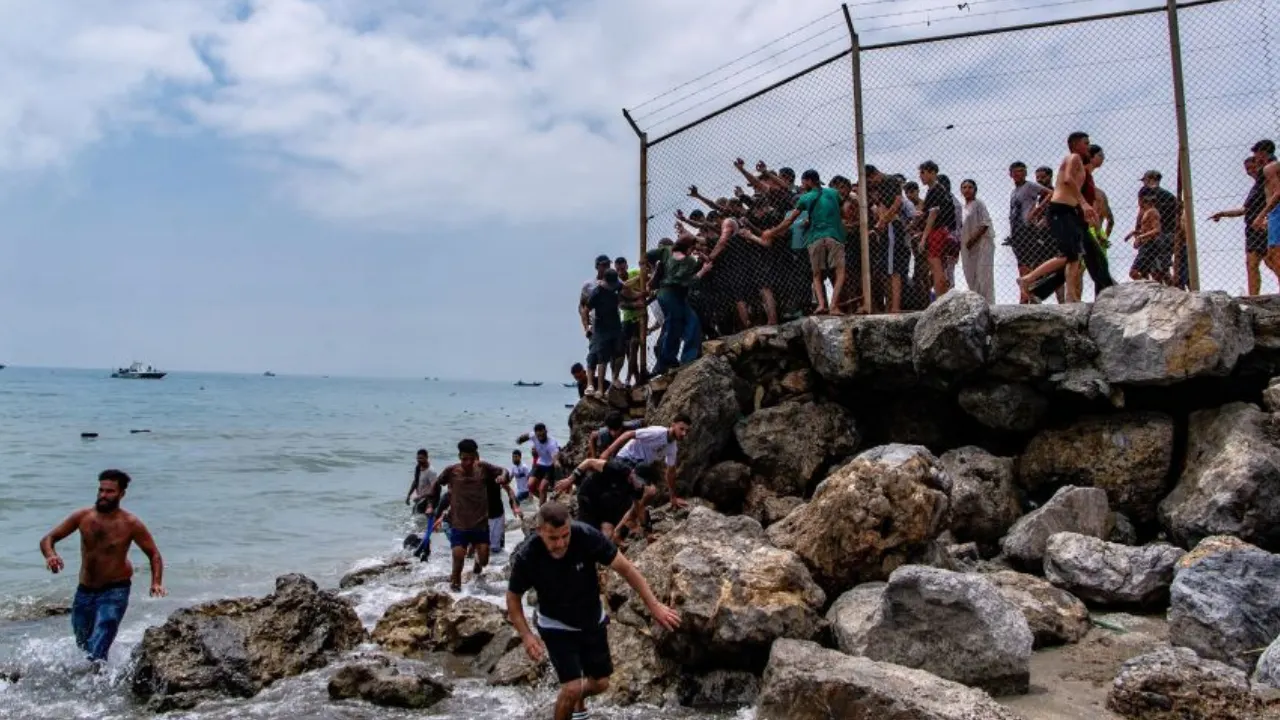

Migrants are swimming into Ceuta because the sea offers a route around the territory’s heavily guarded land border with Morocco. A recent Spanish Supreme Court ruling may have made the maritime route appear more attractive, but officials have not proved that the ruling alone caused the latest mass crossing.
Large groups reached Ceuta by swimming, wading around the Tarajal breakwater or using inflatable flotation devices. Others entered through damaged sections of the land frontier after the number of people approaching the border overwhelmed security forces.
Why is crossing Ceuta by land difficult?
Ceuta is a Spanish autonomous city on the northern coast of Africa. Together with Melilla, it forms the European Union’s only land border with Africa.
Spain has protected the Ceuta–Morocco frontier with tall fencing, surveillance equipment, controlled gates and regular patrols. The official crossing points allow authorities to monitor movement closely, while the border fence makes an unobserved land crossing difficult.
The Tarajal coastline provides an alternative. Migrants can enter the water from the Moroccan side and try to move around the maritime barrier before reaching Spanish-controlled land.
During the latest surge, video footage showed people swimming with inflatable rings while other groups broke through a border gate. The different routes were used at the same time, which placed severe pressure on Spanish and Moroccan security forces.
What did Spain’s Supreme Court change?
Spain’s Supreme Court issued an important ruling on July 8, 2026, concerning migrants intercepted at sea while attempting to swim into Ceuta or Melilla.
The court ruled that Spain cannot use the special summary border-rejection procedure for people intercepted at sea. That procedure applies to people detected while attempting to cross physical border-control structures.
The court said authorities must instead use the ordinary return procedure established under Spain’s immigration law when someone is intercepted in the water. This process includes formal legal steps that an immediate border rejection does not provide.
The ruling does not grant migrants automatic asylum, residency or permission to travel to mainland Spain. It changes the procedure authorities must follow before returning someone intercepted at sea.
Did the court ruling cause migrants to choose the sea?
Ceuta’s regional government believes the ruling changed conditions at the border. Regional president Juan Vivas said the decision prevented authorities from using immediate border rejection against people arriving by water and placed additional pressure on the city’s reception system.
Spain’s Interior Ministry has also accused smuggling networks of using information about the ruling to encourage maritime crossings.
However, the connection remains disputed. Activists and other observers have questioned whether thousands of migrants knew the ruling’s details before approaching the border. Economic hardship, expectations of reaching Europe and rumours circulating through social networks may also have influenced the sudden movement.
The court decision should therefore be described as a possible contributing factor, not the confirmed single cause of the crisis.
Did everyone enter Ceuta by swimming?
Not everyone involved in the surge completed a long open-water swim.
Some people swam or floated around the Tarajal maritime barrier. Others moved through shallow coastal water, crossed near the breakwater or entered through parts of the land frontier after a gate was breached.
Reports describing the overall number of arrivals include entries by both sea and land. Spain’s national security department briefly published an estimate of more than 49,000 crossings within 24 hours, citing the Interior Ministry, but later removed the statement without explanation.
The final number therefore remains uncertain. It is safer to report that tens of thousands were provisionally estimated to have crossed by different routes rather than presenting 49,000 as a settled official total.
Why is the Tarajal sea route so dangerous?
The coastline may allow people to move around the land fence, but it does not provide a safe entry into Ceuta.
Migrants face waves, currents, darkness, exhaustion and collisions around crowded coastal barriers. Many enter the water in ordinary clothing or depend on inflatable rings that offer limited protection.
At least 18 deaths were initially reported after the mass crossing, with most victims drowning or dying during a stampede near Tarajal beach. Reuters later reported that authorities had recovered at least 19 bodies from the water. The toll could change as searches and identification work continue.
Has Spain stopped the crossings?
Spain deployed soldiers, specialist police, a diving unit and a military vessel after local forces became overwhelmed. Morocco also reinforced its side of the frontier and used water-cannon vehicles to prevent additional groups from approaching.
By Friday, the two countries appeared to have largely halted the mass movement, although people were still searching for possible routes near the border.
Migrants are choosing the Ceuta sea route mainly because it provides a way around the fortified land frontier. The Supreme Court ruling may have added another incentive by preventing immediate summary rejection at sea, but it does not guarantee that anyone who reaches Ceuta can remain in Spain.
