

Updated: August 6, 2026
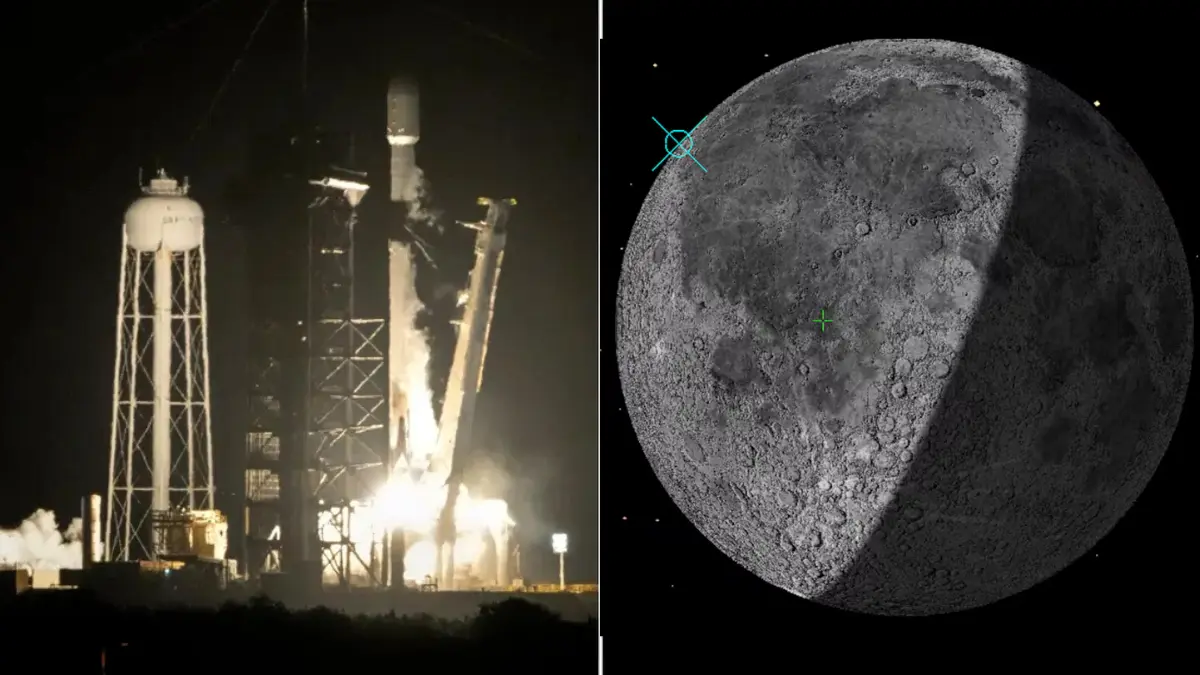
A spent SpaceX Falcon 9 upper stage hit the Moon on August 5, 2026, approximately 18 months after completing its original launch mission. This was not a new Falcon 9 launch failure or an active rocket losing control.
The stage struck the Moon because the January 2025 mission left it in a highly stretched orbit around Earth. Solar activity and the combined gravitational influence of Earth, the Moon and the Sun gradually changed that orbit until it crossed the lunar surface. NASA described the return to the Moon as unplanned.
The impact occurred at approximately 06:34 UTC near the Einstein and Bell crater region on the lunar far side. South Korea’s Danuri lunar orbiter has since captured observations from before and after the collision, confirming changes to the surface near the predicted impact point.
What Part of the Falcon 9 Hit the Moon?
The object was the Falcon 9 rocket’s spent upper stage, also called its second stage. It was not the reusable first-stage booster commonly seen returning to Earth, and it was not carrying astronauts or an active lunar lander.
SpaceX launched the Falcon 9 from NASA’s Kennedy Space Center on January 15, 2025. The mission carried Firefly Aerospace’s Blue Ghost Mission 1 and ispace’s Resilience lunar lander. Both spacecraft separated from the rocket stage and continued on their independent journeys toward the Moon.
After deploying the spacecraft, the upper stage remained in space as spent rocket hardware. Astronomers catalogued it as 2025-010D.
Researchers later reconstructed the object’s previous orbit and connected it to the January 2025 launch. Observations of its shape, rotation and reflected light also matched the physical characteristics of a Falcon 9 upper stage rather than a natural asteroid.
This is why the widely used phrase “SpaceX rocket crashes on the Moon” needs context. An entire functioning rocket did not crash. A discarded upper stage struck the lunar surface long after it had successfully completed its role in the launch.
Why Did the Upper Stage Remain in Space?
The mission needed to send two landers far beyond low Earth orbit and onto trajectories toward the Moon. After releasing those payloads, the upper stage did not immediately fall back into Earth’s atmosphere.
Instead, it entered a highly elliptical, or stretched, orbit around Earth. A pre-impact scientific analysis estimated that the stage travelled as close as approximately 9,400 kilometres from Earth and as far as approximately 377,000 kilometres away. Its most distant point was therefore close to the Moon’s average distance from Earth.
That orbit repeatedly carried the stage through cislunar space, the region where both Earth and the Moon strongly influence an object’s movement.
NASA did not classify the later collision as a new launch accident. The agency said the lunar return was unplanned, while also noting that controlled lunar impacts can be an accepted end-of-life disposal method for certain missions. This particular stage, however, was not originally directed toward the impact site where it eventually landed.
How Did Its Orbit Change Over 18 Months?
The Falcon 9 stage did not travel directly from its January 2025 launch to the Moon. It continued orbiting Earth for roughly a year and a half.
During that time, several forces continuously affected its trajectory.
Earth’s gravity remained the primary force controlling the stage’s orbit, but the Moon’s gravity pulled on it whenever it travelled through the distant part of that orbit. The Sun also affected its path through gravity and solar activity.
Each change could be relatively small during a single orbit. Over many months, however, those changes accumulated. NASA said solar activity and gravitational forces eventually caused the stage’s unplanned return toward the Moon.
Researchers tracking 2025-010D calculated that it would strike between the Einstein and Bell craters at approximately 2.4 kilometres per second, or about 8,700 kilometres per hour. Their orbital models showed that the collision had become unavoidable.
The Moon has almost no atmosphere, so the stage did not experience the kind of atmospheric resistance that burns up many objects returning to Earth. Nothing significantly slowed it before it reached the lunar surface.
How Was the Moon Impact Confirmed?
South Korea’s Danuri, officially known as the Korea Pathfinder Lunar Orbiter, observed the impact area eight times.
The spacecraft completed one observation approximately 30 minutes before the collision and seven follow-up observations afterward. Danuri finished the observation campaign on the morning of August 6.
According to the Korea AeroSpace Administration, the resulting images revealed terrain changes near the impact location and signs that material had spread outward from the site. Danuri had also photographed the area in July, giving scientists earlier images for comparison.
Researchers have not yet released a final measurement of the new crater.
Pre-impact estimates differed because crater formation depends on the stage’s mass, impact angle and the physical properties of the ground. NASA predicted a crater approximately 60 feet, or 18 metres, wide, while a scientific model estimated a diameter closer to 40 metres.
Danuri’s data will now help scientists determine the crater’s actual size, shape and ejecta pattern. NASA’s Lunar Reconnaissance Orbiter is also expected to conduct follow-up observations of the area.
The August 5 collision was therefore not a sudden SpaceX mission failure. It was the delayed result of a spent upper stage remaining in a distant Earth orbit where gravitational and solar influences gradually redirected it toward the Moon.
Because researchers knew the object’s origin and tracked its trajectory before impact, the event also offers a rare opportunity to compare predicted lunar-impact models with real changes observed on the surface.
