
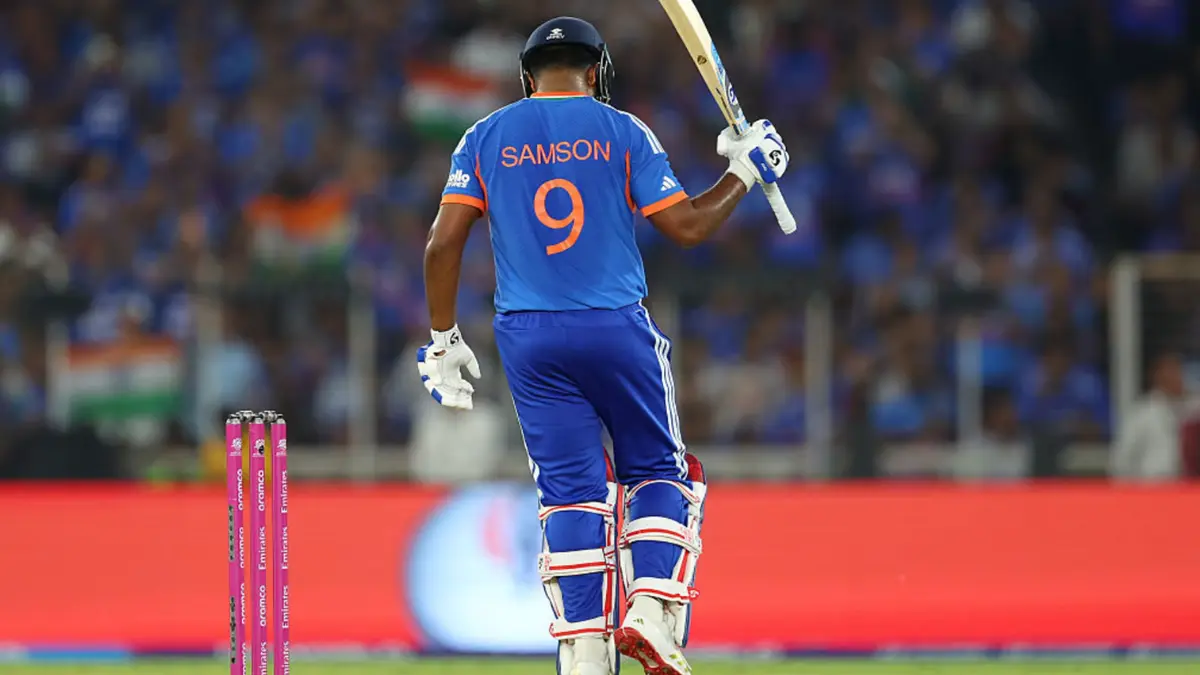

Sanju Samson’s “Sanju will decide for Sanju” statement means he no longer wants selection pressure or outside opinions to dictate how he approaches cricket. He wants to trust his preparation, experience and natural batting method while enjoying the remaining years of his career.
The statement does not mean Sanju Samson has retired, rejected the Indian team or made himself unavailable for selection. It describes a change in his mindset after years of uncertainty over his place in India’s squads and playing eleven.
Samson made the comment during an appearance on JioStar’s show Believe. He explained that he had decided before the 2026 T20 World Cup that he would no longer participate emotionally in what he called a constant “rat race.”
His message was simple: he cannot control whether selectors choose him, but he can control how he prepares, bats and responds to every opportunity.
What Does ‘Sanju Will Decide for Sanju’ Mean?
The phrase means Samson wants to make his own cricketing decisions without allowing fear, criticism or competition for places to change his identity as a player.
Samson has spent much of his international career moving in and out of India’s plans. Every opportunity brought pressure because one unsuccessful innings could create another debate about whether he deserved a place.
That uncertainty can influence a player’s natural game. A batter who believes every match may be his last chance can start forcing shots, changing his technique or trying to satisfy every public opinion.
Samson now appears determined to avoid that pattern.
He wants to listen to his own understanding of the game. He knows which shots suit him, how he prepares for different bowlers and when a match situation requires aggression or patience.
“Sanju will decide for Sanju” does not mean he will ignore coaches, captains or team plans. Team cricket still requires players to follow assigned roles and respond to match situations.
The statement instead reflects personal confidence. Samson does not want fear of being dropped to decide how he bats.
He also does not want every new competitor or squad announcement to control his emotional state. He wants to remain ready, perform when selected and accept the decisions that remain outside his control.
Why Did Sanju Samson Say He Was Leaving the ‘Rat Race’?
Samson used the “rat race” expression to describe the constant competition and comparison surrounding Indian cricket selection.
India has more talented players than available positions. Several aggressive batters can open the innings, while multiple wicketkeepers can also contribute as top-order or middle-order players.
That depth creates intense competition. A player may perform well in one series but still face questions about form, strike rate, batting position, age or team balance.
Samson has experienced this uncertainty repeatedly.
Even after proving that he can produce important international innings, he has not always received a fixed role or uninterrupted sequence of matches. Public discussions about his place often return after only a small number of low scores.
His latest statement suggests that he has accepted the reality of this competition without allowing it to dominate his career.
Samson said he is now 31 and understands that his playing career will not continue forever. Instead of spending the remaining years chasing permanent security, he wants to enjoy cricket and play with greater freedom.
Leaving the “rat race” therefore does not mean leaving the sport. It means refusing to build his entire sense of success around selection.
Is Sanju Samson Retiring From International Cricket?
No, Sanju Samson has not announced his retirement from international cricket.
He did not say that he was leaving T20 internationals, refusing future India opportunities or ending his professional career.
Samson made it clear that he would continue playing and supporting the teams he represents. He also spoke about remaining a good teammate while following his own approach to the game.
Retirement speculation grew because he mentioned his age, the limited number of years remaining in his career and his decision to stop participating in the selection race.
Those comments may sound like a farewell when separated from the rest of his explanation. However, the complete message points toward a new attitude rather than an immediate exit.
Samson wants to continue playing without making distant promises about tournaments that are still years away. He understands that form, fitness, competition and team requirements can change quickly.
A formal retirement announcement would require a clear statement from Samson or confirmation from the relevant cricket authorities. No such announcement accompanied his “Sanju will decide for Sanju” comment.
Claims that he has retired or permanently walked away from India selection are therefore inaccurate.
Was Samson Criticising India’s Selectors?
Samson did not directly accuse the selectors, coaches or team management of treating him unfairly.
His comments focused on how he personally handles uncertainty. He spoke about controlling his own decisions rather than attacking the people who decide India’s squads.
The statement may naturally remind supporters of the inconsistent opportunities he has received. Fans have often debated whether India gave him enough continuity or a clearly defined role.
However, those debates should not be presented as Samson’s direct accusation.
He did not name any selector or coach. He also did not demand a place in the team or compare his treatment with that of another player.
Instead, Samson shifted attention toward the parts of his career that remain within his control.
He can maintain his fitness, study bowlers, improve his skills and prepare for matches. He cannot guarantee selection or prevent another player from performing well.
His words show that he no longer wants to spend excessive energy worrying about those uncontrollable decisions.
This distinction matters. The statement contains confidence and possibly reflects years of frustration, but it is not a public attack on the Indian cricket system.
Why Was Sanju Samson Left Out of the Zimbabwe Squad?
Sanju Samson was not selected for India’s three-match T20I series against Zimbabwe in July 2026.
The squad named Ishan Kishan and Prabhsimran Singh as its wicketkeeping options. It also included several batters competing for places in India’s changing T20I combination.
Samson’s omission followed a brief dip in his scores during matches against Ireland and England. Several news reports connected those performances with his absence from the Zimbabwe tour.
However, the BCCI did not publicly explain why the selection committee left him out.
Player absences can happen for very different reasons, so they should not automatically be treated as performance-based decisions. A recent example was Shaheen Afridi’s LPL team-sheet controversy, where an administrative error prevented him from playing despite reports that he was expected to be available.
It would therefore be inaccurate to claim that poor form was the officially confirmed reason. Selection can involve several factors, including workload, experimentation, team balance, future planning and opportunities for other players.
The official announcement only confirmed the chosen squad. It did not describe Samson’s omission as permanent or announce that India had ended his international career.
His absence from one tour does not automatically mean that selectors will never consider him again.
It does show that competition for India’s opening and wicketkeeping positions remains intense. Samson will need strong performances whenever his next opportunities arrive, but the Zimbabwe decision alone does not close the door on a return.
What Did Samson Say About the 2028 T20 World Cup?
Samson did not set the 2028 T20 World Cup as a guaranteed career target.
He explained that after the 2024 World Cup, he did not know whether he would even reach India’s squad for the 2026 tournament. That experience taught him how quickly a player’s position can change.
Samson eventually played an important role during India’s successful 2026 campaign. However, that achievement did not convince him to make confident predictions about another tournament two years later.
His position appears practical rather than pessimistic.
He believes that a 2028 opportunity will depend on whether he is playing well, whether the team needs him and whether the selectors believe he fits the required combination.
Samson did not rule himself out. He also did not promise that he would remain in India’s plans.
This approach fits the wider meaning of “Sanju will decide for Sanju.” He can decide how seriously he trains and how freely he plays, but he cannot decide the future Indian squad.
Instead of allowing a distant tournament to create more pressure, he wants to focus on his current cricket.
What Does Playing on His Own Terms Mean for Samson’s Batting?
Playing on his own terms means trusting the batting method that Samson has developed through experience.
It does not mean playing selfishly or ignoring the match situation. Samson still has to contribute to the team’s objective and adjust his approach when conditions demand it.
The difference lies in his mental state.
A player worried about selection may feel compelled to attack immediately, prove his value in a few balls or avoid every possible mistake. That pressure can disrupt judgment and produce the very failures the player fears.
A confident batter can respond more naturally.
Samson described how he learned to remain patient even in high-pressure World Cup matches. He trusted that facing a few dot balls would not prevent him from accelerating later.
That confidence allowed him to make decisions based on the match rather than on public expectations.
He also reflected on preparing to face difficult opponents without allowing earlier dismissals to create fear. His experience taught him that proper preparation matters more than repeated reminders about past failures.
Playing on his own terms therefore means accepting responsibility for his choices. When he attacks, defends or takes time at the crease, he wants those decisions to come from clarity rather than panic.
Can Sanju Samson Still Return to India’s T20I Team?
Yes, Sanju Samson can still return to India’s T20I team, although he faces strong competition.
India has several batters capable of opening the innings aggressively. The selectors can also choose from multiple wicketkeepers depending on the required team balance.
Samson still offers useful qualities.
He can bat at the top of the order, accelerate quickly, keep wickets and handle major-match pressure. His experience may also become valuable when India needs a settled player rather than another short-term experiment.
His route back will depend mainly on form, fitness and the combinations India chooses for future series.
Strong performances in domestic cricket, franchise tournaments or future international opportunities can return him to serious contention. Injuries or changes in form among other players can also reopen positions unexpectedly.
Samson’s statement suggests that he understands these possibilities but no longer wants to follow every selection development anxiously.
He will prepare and perform, but he does not want another player’s success to feel like a personal crisis.
That calmer approach may help him. A player who feels free from desperation can often make clearer decisions and produce more consistent cricket.
What Is the Real Message Behind Samson’s Statement?
Samson’s statement is mainly about controlling his mindset rather than controlling selection.
He cannot decide whether India names him in the next squad. He can decide how he prepares, how he bats and how he reacts when selectors choose someone else.
“Sanju will decide for Sanju” does not represent retirement, rebellion or rejection of Team India. It represents a player choosing self-belief after years of uncertainty.
Samson remains available to play and contribute. Whether another India opportunity arrives will depend on his performances, the team’s requirements and the selectors’ plans.
The difference is that he no longer wants those uncertain decisions to determine how much he enjoys the game.

2 thoughts on “Sanju Samson Says ‘Sanju Will Decide for Sanju’—Meaning”