
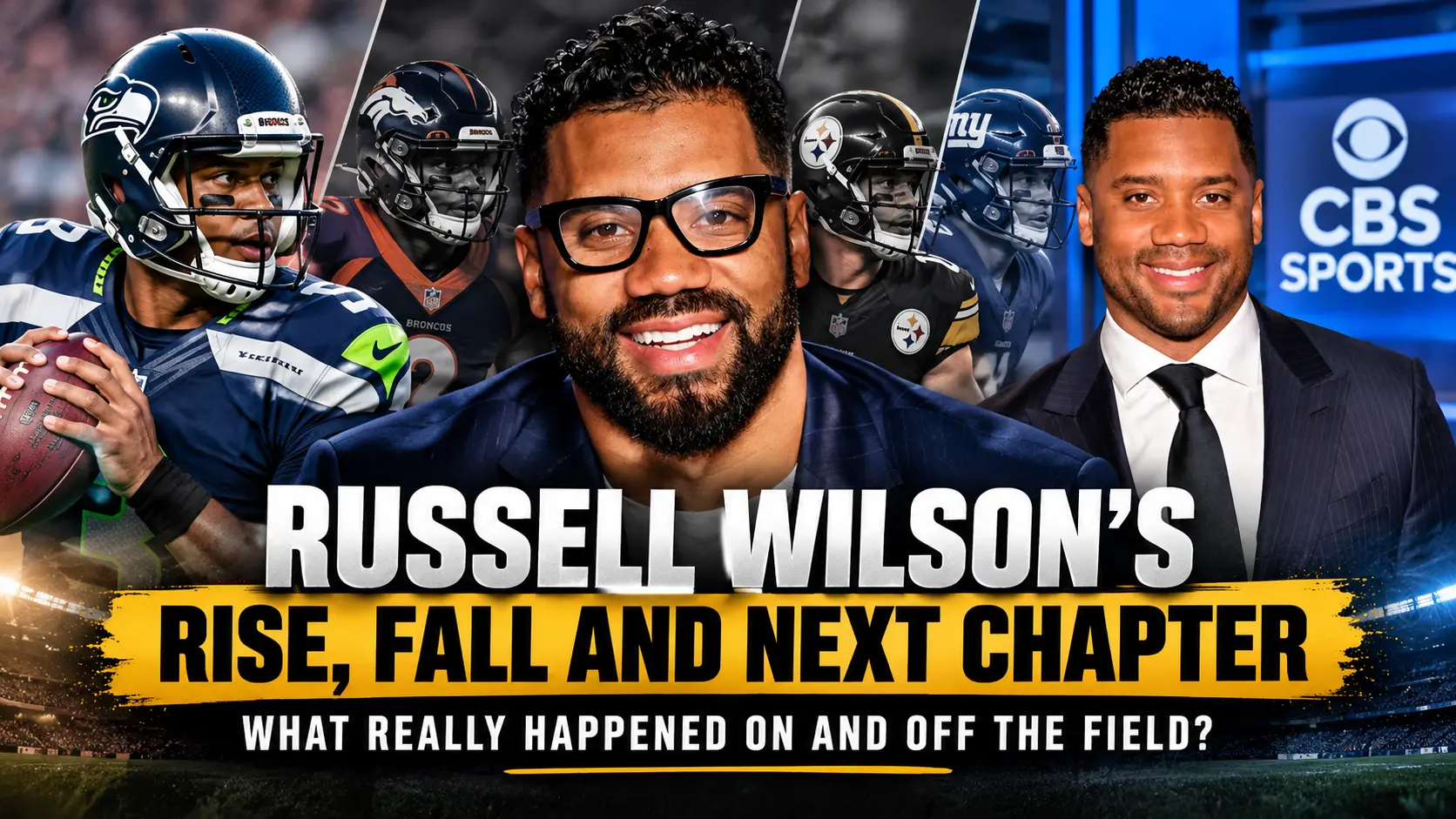

Russell Wilson spent more than a decade building one of the most recognizable quarterback careers of his generation. He won Super Bowl XLVIII with the Seattle Seahawks, reached another Super Bowl the following season and earned 10 Pro Bowl selections across his career.
He also became known for extending broken plays, escaping pressure and delivering deep passes that few quarterbacks could consistently make. For much of his Seattle career, that combination made him one of the NFL’s most dangerous quarterbacks.
Now, however, the conversation around Wilson has changed dramatically. After 14 NFL seasons covering Seattle, Denver, Pittsburgh and New York, Wilson announced in June 2026 that he was entering a new chapter with CBS Sports and The NFL Today.
His farewell video carried the message “Thank You, Football. Love, #3,” and was widely interpreted as the closing of his playing career. Wilson did not explicitly use the word “retirement,” so a future return was not presented as absolutely impossible.
Still, his decision to join CBS after also having an opportunity to remain in the league as a backup makes broadcasting his clear next step. The announcement renewed interest in the larger Russell Wilson story.
Fans are again asking how a quarterback who spent most of his Seattle career among the NFL’s biggest stars ended up being released by Denver. They are also asking why he spent only one season in Pittsburgh before losing his starting job with the New York Giants after three games.
What Is Going On With Russell Wilson?
Wilson’s playing career appears to have reached its end after 14 NFL seasons. On June 3, 2026, he published his “Thank You, Football. Love, #3” video while confirming that he would join CBS Sports’ The NFL Today.
CBS added the 10-time Pro Bowl quarterback to its Sunday pregame team for the 2026 season. The move represents a major change for a player who spent his first decade with one franchise.
Seattle drafted Wilson in the third round of the 2012 NFL Draft. He quickly won the starting job and developed into the quarterback of one of the defining teams of the 2010s.
Wilson earned nine Pro Bowl selections during his 10 seasons in Seattle. He also helped the Seahawks reach consecutive Super Bowls.
The high point came in Super Bowl XLVIII, when Seattle defeated the Denver Broncos 43-8. Ironically, Denver later became the place where the second phase of Wilson’s career began.
2022–2023: Denver Broncos
Seattle traded Wilson to Denver before the 2022 season in one of the biggest transactions in recent NFL history. The Broncos then gave him a five-year extension worth $245 million before he had played a regular-season game for the franchise.
That contract created enormous expectations immediately. The results fell well short of them.
Denver went through coaching instability, offensive problems and a deeply disappointing 2022 season. Wilson finished that year with 16 touchdown passes against 11 interceptions while taking 55 sacks.
The offense never developed into the explosive unit many expected. Wilson also looked far less comfortable than he had during his best years in Seattle.
Sean Payton became Denver’s head coach in 2023, and Wilson’s numbers improved. He completed 66.4 percent of his passes and threw 26 touchdowns against eight interceptions.
2024: Pittsburgh Steelers
Wilson’s move to Pittsburgh offered a temporary reset. After dealing with a calf injury early in the season, he eventually became the Steelers’ starter.
He started 11 regular-season games, going 6-5 while throwing for 2,482 yards with 16 touchdowns and five interceptions. The season also brought Wilson his 10th career Pro Bowl selection.
His 2024 performance showed that he could still function as an NFL starter in the right environment. Pittsburgh could use his experience and deep-ball ability without expecting him to recreate his athletic Seattle prime.
The Steelers, however, did not turn the arrangement into a long-term commitment. Wilson once again entered the market looking for another opportunity.
That opportunity came with the New York Giants. It would become the final major chapter of his playing career.
2025: New York Giants
Wilson joined the Giants in 2025 and opened the season as their starter. His time in that role lasted only three games.
New York began 0-3. Wilson did produce a remarkable 450-yard, three-touchdown performance against Dallas, but the broader offensive results were not strong enough to keep the rookie quarterback on the bench.
Head coach Brian Daboll then announced that first-round rookie Jaxson Dart, selected No. 25 overall in the 2025 draft, would take over as the starter. Wilson remained on the roster and publicly supported Dart.
The change represented something larger than one ordinary quarterback switch. For the first time, it became difficult to view Wilson as a veteran merely waiting for his next franchise-starting opportunity.
The NFL was moving toward a younger generation of quarterbacks while Wilson was approaching 38. That reality helped set the stage for his move to CBS in 2026.
The On-Field Downfall
The question “What was the downfall of Russell Wilson?” suggests that one event destroyed his career. There was no single moment when everything changed.
Wilson’s decline happened gradually. The physical abilities and offensive conditions that helped make his playing style extraordinary became harder to reproduce as he aged.
His Game Was Built Around Creating Outside Structure
Prime Wilson was dangerous because the first play did not always have to work. He could escape the pocket and extend a play for several seconds.
That forced defensive backs to cover receivers much longer than normal. Wilson then combined that mobility with excellent touch on deep passes.
He was especially dangerous when a conventional offensive structure broke down. Some of his most memorable plays came after protection failed or when the original route concept had already dissolved.
That style becomes harder to sustain as quarterbacks age. As Wilson moved deeper into his 30s, escaping pressure and creating explosive plays outside the pocket became more difficult.
Defenses no longer had to fear his legs to quite the same degree. That made other parts of his game more important.
Why Was Russell Wilson Benched in Denver?
Sean Payton’s arrival made the contrast between Wilson’s strengths and Denver’s preferred offensive structure especially important. Payton traditionally favored timing, defined reads and getting the football out efficiently.
Wilson, by contrast, had spent much of his career succeeding through improvisation and off-schedule creation. Those approaches were not automatically incompatible.
The partnership, however, never became comfortable enough to last. Wilson’s 2023 statistics were considerably better than his 2022 numbers, so describing the benching as simply a response to poor play would be misleading.
Why Was Russell Wilson Benched by the Giants?
The Giants benching had a different context. New York had already drafted Jaxson Dart in the first round.
That meant Wilson was effectively serving as a veteran bridge while the organization prepared its hoped-for long-term quarterback. The Giants then started 0-3.
Against Kansas City in Week 3, Wilson completed 18 of 32 passes for 160 yards. He threw no touchdowns and was intercepted twice as New York scored only nine points.
Daboll responded by turning to Dart. The coach declined to explain every factor behind the decision, saying only that he believed starting the rookie was the right move for the team.
That distinction matters. Wilson was not necessarily benched because he had become incapable of playing NFL football.
New York had a first-round quarterback waiting behind a 37-year-old veteran. An 0-3 start dramatically reduced the reason to delay that transition.
Why Did the Starter Market Dry Up?
The popular search question “Why does no one want Russell Wilson?” overstates what actually happened. NFL teams continued to want him.
Pittsburgh signed him in 2024, and New York signed him in 2025. Wilson also reportedly had an opportunity to join another team as a backup in 2026 before choosing CBS instead.
What disappeared was not all NFL interest. It was the market for Russell Wilson as an unquestioned long-term franchise starter.
Several factors contributed to that shift. Wilson was in his late 30s, and his mobility was no longer what it had been during his Seattle peak.
He had also moved through Denver, Pittsburgh and New York in four seasons. Teams therefore had to decide whether their offensive systems still matched his remaining strengths.
Why Don’t Some NFL Players Like Russell Wilson?
Few parts of Wilson’s career are more complicated than his locker-room reputation. The search query “Why don’t NFL players like Russell Wilson?” starts from a premise that is too broad.
There is no evidence that NFL players collectively dislike him. There is, however, evidence that Wilson became a polarizing personality in some locker rooms.
His highly controlled public image became a recurring talking point. So did his leadership style and reports of perceived special treatment.
Those issues became especially prominent after Seattle’s championship-era roster began to break apart. Success had previously made many of those personality differences easier to overlook.
The Curated Public Image
Wilson has always maintained an unusually polished public persona. His motivational language, business ventures, carefully delivered interviews and personal branding made him different from many NFL personalities.
Phrases such as “Mr. Unlimited” became part of that image. For supporters, the approach reflected professionalism and discipline.
For critics, the same qualities sometimes felt overly rehearsed or performative. Those interpretations became more noticeable when the Seahawks were no longer winning at the same level.
Traits that once seemed harmless could suddenly become subjects of criticism. That is common with high-profile athletes when team success begins to decline.
Seahawks Locker-Room Dynamics
Reports from the Legion of Boom era described resentment among some players who believed Wilson received different treatment from head coach Pete Carroll. Later reporting suggested that certain Seahawks players felt he was afforded special treatment.
There were also suggestions that Wilson stood apart socially from parts of the roster. Those reports helped create the long-running narrative that he was isolated from some teammates.
Richard Sherman later acknowledged that he and Wilson were not personally close. That does not automatically imply hostility.
NFL locker rooms contain dozens of personalities. Not every successful teammate relationship is also a close personal friendship.
There is also important evidence pointing in the opposite direction. Sherman had previously called reports of a fractured relationship overblown and described Wilson as a strong teammate.
Michael Bennett also publicly defended Wilson when stories of locker-room division emerged. That contradiction is important.
Cultural Contrast
Wilson’s leadership style was also simply different. Some NFL locker rooms place enormous value on informal bonding, direct communication and personalities that appear unfiltered.
Wilson approached leadership in a more structured and carefully presented way. That difference could make him polarizing without making him ineffective.
His later career produced evidence that teammates still respected his professionalism and experience. After the Giants replaced him with Dart, Wilson publicly supported the rookie instead of turning the quarterback change into a public conflict.
Giants reporting noted that Wilson told Dart, “I got your back,” after the change. That response does not fit neatly with the idea that Wilson was universally disliked or difficult to work with.
Marriage, Divorce and Family
Wilson’s personal life has attracted almost as much online speculation as his football career. Much of that interest centers on his first marriage and his relationship with Ciara.
Celebrity relationships naturally generate rumors. In Wilson’s case, separating verified information from unsupported claims is especially important.
Ashton Meem: 2012–2014
Wilson married his longtime girlfriend Ashton Meem in 2012, shortly before Seattle selected him in the NFL Draft. The two had known each other since high school.
Their relationship therefore predated Wilson’s rise to national NFL fame. They were already together before his career transformed him into a major sports celebrity.
In April 2014, only a few months after the Seahawks won Super Bowl XLVIII, Wilson announced that he had filed for divorce. His public statement described it as a difficult decision.
He also asked for understanding and privacy. Wilson made clear that he would not discuss the matter in detail.
That limited explanation created room for years of online speculation. Various rumors circulated about why the marriage ended.
Some of those rumors involved people connected to Wilson’s football career. They have often been repeated online as though they were established facts.
They were not. Neither Wilson nor Meem publicly provided a detailed verified explanation establishing those rumors as the cause of the divorce.
The responsible answer to “What happened between Russell Wilson and his ex-wife?” is therefore simple. They married in 2012, Wilson filed for divorce in 2014, and the private reasons behind the breakup were never publicly established in enough detail to justify the more sensational claims.
Ciara: 2015–Present
Wilson’s relationship with singer Ciara began the following year. The couple started dating in 2015 and became engaged in March 2016.
They married at Peckforton Castle in England in July 2016. Their relationship subsequently became one of the NFL’s most visible celebrity marriages.
Wilson and Ciara have three children together: Sienna, Win and Amora. Wilson is also part of the life of Ciara’s older son, Future Zahir.
Their public partnership extends beyond entertainment and football. Through the Why Not You Foundation, Wilson and Ciara have supported programs connected with education, children’s health, food security and poverty reduction.
Wilson and Ciara have also repeatedly spoken publicly about faith and family. Those themes have remained central to the public image of their marriage.
Questions such as “What happened with Russell Wilson and his wife?” occasionally spike because celebrity relationships generate constant speculation. As of 2026, however, there is no verified public breakup between Wilson and Ciara.
They remain publicly presented as partners in family, business and charitable work. Online rumors should therefore not be treated as evidence of a separation.
