
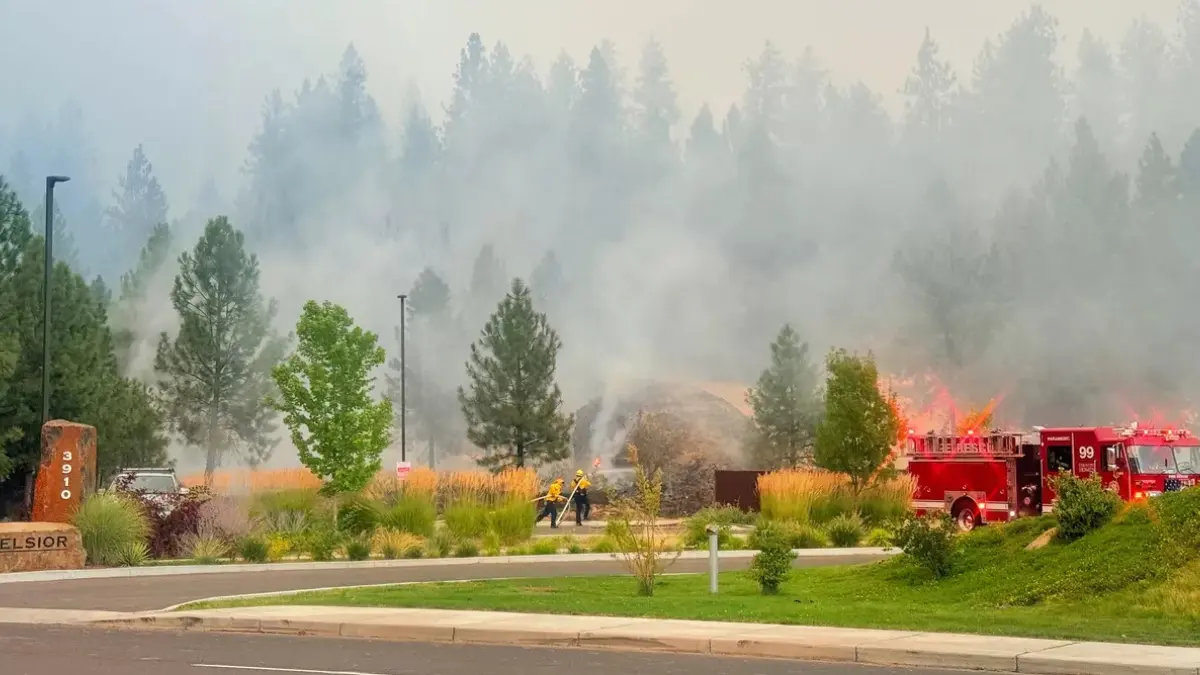

The Old Trails Fire crossed the Spokane River during its rapid advance through northwest Spokane, but officials have not publicly confirmed exactly how the crossing happened. Wind-driven spotting, which occurs when burning embers travel ahead of a wildfire and ignite new areas, offers the clearest scientific explanation.
The Old Trails Fire began on Saturday, August 1, 2026, in an open area of grass and brush northwest of Spokane. Strong winds quickly pushed the fire north and east toward residential areas.
Officials later confirmed that the fire had crossed the Spokane River. The crossing allowed the wildfire to establish itself closer to populated parts of northwest Spokane and contributed to rapidly expanding evacuation orders.
However, the phrase “crossed the river” does not necessarily mean that a continuous wall of flames burned across the water.
What Did Officials Confirm About the River Crossing?
Officials confirmed that the Old Trails Fire moved beyond the Spokane River as it spread toward residential areas.
They have not released a detailed fire-behaviour analysis showing the precise location or physical process behind the crossing. They have also not confirmed that flames moved directly across the river’s surface.
The available facts establish three important points:
- The wildfire began in grass and brush.
- Strong winds drove its rapid movement.
- The fire established itself on the opposite side of the Spokane River.
Fire science can explain how this type of crossing commonly happens, but it cannot prove the exact mechanism until incident officials release more information.
How Can a Wildfire Cross a River?
A wildfire can cross a river through a process known as spotting.
During intense burning, rising hot air can lift burning pieces of bark, leaves, branches and other vegetation above the main fire. Winds can then carry those embers beyond the visible flames.
Some embers lose their heat before reaching the ground. Others remain hot enough to ignite dry vegetation after landing.
When an ember starts a separate fire ahead of the main fire front, firefighters call it a spot fire. Several spot fires can develop at once when strong winds carry large amounts of burning material through the air.
A river can interrupt flames moving through grass or brush at ground level. It cannot block embers travelling above the water.
If those embers reach dry grass, shrubs, trees or another combustible surface on the opposite bank, they can create a new burning area. The wildfire then appears to have jumped the river even though the main flames may never have burned directly across the water.
Why Did Spokane’s Fire Conditions Matter?
The Old Trails Fire developed during dangerous wildfire conditions involving strong winds, high temperatures, dry vegetation and low moisture.
Wind can increase wildfire danger in several ways. It supplies fresh oxygen, bends flames toward unburned vegetation and pushes the fire toward new fuel. It can also lift and carry burning embers far ahead of the main fire.
Dry vegetation makes those airborne embers more dangerous. Grass, leaves and small branches can ignite quickly when they contain little moisture.
Washington had already been experiencing severe drought conditions when the fire began. State officials declared a wildfire emergency and issued a statewide burn ban as high temperatures and strong winds increased the danger across Washington.
These conditions do not prove that spotting caused the Old Trails Fire to cross the Spokane River. They show why ember transport was possible and why new fires could develop quickly after burning material reached the opposite bank.
Did Flames Burn Directly Across the Water?
No official report has confirmed that flames burned continuously across the surface of the Spokane River.
Water removes the connected vegetation that normally carries a surface fire forward. A fire cannot move through deep water in the same way that it moves through grass, shrubs or forest litter.
However, rivers are not guaranteed wildfire barriers.
Wind-driven wildfires can send embers across rivers, lakes, roads, firelines and other breaks in vegetation. The new ignition on the opposite side may then grow independently of the original fire front.
For this reason, saying that a wildfire “jumped a river” usually describes where the fire reappeared, not flames travelling across the water itself.
Was Spotting Definitely Responsible?
Spotting is the strongest fire-science explanation, but officials have not confirmed it as the exact cause of this crossing.
Other incident details, including the fire’s direction, local terrain, ember movement and the first ignition point beyond the river, would be needed to establish the precise sequence.
The investigation into what originally started the Old Trails Fire also remains separate from the river-crossing question. The ignition cause explains how the wildfire began. Spotting would explain how an already active fire reached new ground beyond a natural barrier.
Until officials release a detailed assessment, the most accurate conclusion is clear: the Old Trails Fire crossed the Spokane River during extreme wind-driven conditions, and airborne embers provide a credible explanation for how it could have happened.
The incident also shows why residents should not treat a river, road or cleared area as guaranteed protection when emergency officials issue evacuation orders.

1 thought on “How Could the Old Trails Fire Cross the Spokane River? What We Know”