
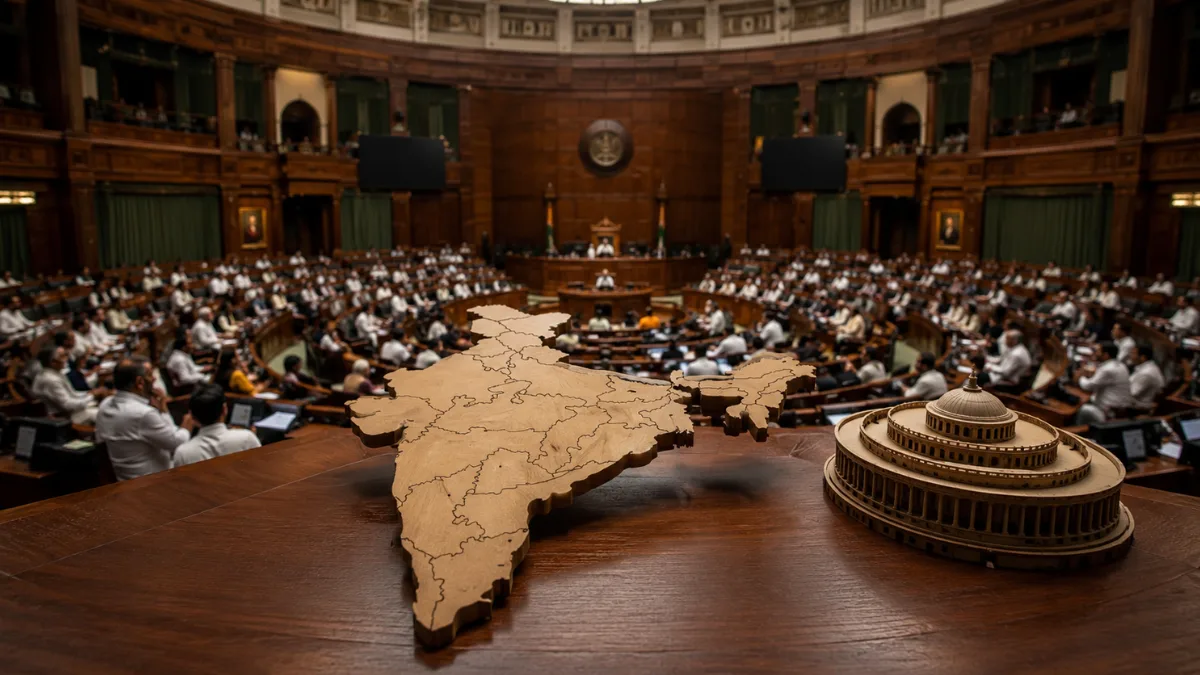

The Delimitation Bill, 2026 was a proposal to redistribute Lok Sabha and State Assembly seats and redraw constituency boundaries based on population. It did not become law because the connected constitutional amendment failed in the Lok Sabha on April 16, 2026.
The official parliamentary database still lists the separate Delimitation Bill as pending. However, it could not move forward after the Constitution (131st Amendment) Bill was defeated. PRS Legislative Research describes the ordinary bill as infructuous, meaning it lost its practical purpose once the constitutional amendment failed.
As of July 26, 2026, India has not introduced the new constituency system proposed under the 2026 package. The existing Lok Sabha and Assembly constituencies remain in place.
What Does Delimitation Mean in India?
Delimitation means redrawing the boundaries of electoral constituencies and deciding how many seats different states and union territories should receive.
Every Lok Sabha and State Assembly constituency represents voters living within a specific geographical area. Population changes can gradually make some constituencies much larger than others, even though each constituency continues to elect only one representative.
A delimitation exercise can:
- Redraw Lok Sabha constituency boundaries.
- Redraw State Assembly constituency boundaries.
- Increase the total number of constituencies.
- Redistribute Lok Sabha seats among states.
- Identify seats reserved for Scheduled Castes and Scheduled Tribes.
- Select and rotate constituencies reserved for women.
- Move towns, districts or local areas into different constituencies.
The main objective is to keep political representation reasonably balanced. However, redistribution can also increase the political influence of some states while reducing the relative influence of others.
That is why delimitation is not simply an exercise in drawing a new electoral map. It can change the balance of power inside Parliament.
Why Is India Discussing Delimitation Again?
The present distribution of Lok Sabha seats among states remains based largely on population figures from the 1971 Census.
India originally planned to adjust parliamentary representation after every census. Parliament later froze the state-wise allocation of seats so that states which controlled population growth would not lose political representation.
The 42nd Constitutional Amendment introduced the original freeze in 1976. The 84th Constitutional Amendment later extended it until the publication of the first census conducted after 2026.
India has redrawn constituency boundaries during this period. The Delimitation Commission constituted in 2002 used 2001 Census figures to adjust boundaries within states.
However, it did not conduct a complete nationwide redistribution of Lok Sabha seats among states according to their newer population shares.
Different states have experienced very different rates of population growth since 1971. As a result, one MP may represent significantly more people in one state than an MP represents in another.
Supporters of fresh delimitation argue that this difference weakens equal representation. Critics argue that states which successfully reduced population growth should not lose their share of national political power.
What Did the Delimitation Bill 2026 Propose?
The central government introduced three connected bills in the Lok Sabha on April 16, 2026:
- The Constitution (One Hundred and Thirty-First Amendment) Bill, 2026.
- The Delimitation Bill, 2026.
- The Union Territories Laws (Amendment) Bill, 2026.
The constitutional amendment proposed changing the rules governing seat allocation, the maximum size of the Lok Sabha and the census that could be used for the exercise.
The Delimitation Bill provided the legal process for forming a Delimitation Commission and carrying out the redistribution of seats.
The Union Territories Laws amendment proposed related changes for legislatures and constituencies in union territories.
Under the package, the Delimitation Commission would have determined:
- How many Lok Sabha seats each state and union territory should receive.
- How many Assembly seats each state should have.
- Where parliamentary and Assembly constituency boundaries should be drawn.
- Which seats should be reserved for Scheduled Castes.
- Which seats should be reserved for Scheduled Tribes.
- Which constituencies should be reserved for women.
The commission would have considered population, geographical features, existing administrative boundaries, communication facilities and public convenience.
As far as practical, constituencies would have remained geographically compact. Each Assembly constituency would also have remained entirely within one parliamentary constituency.
Who Would Have Served on the Delimitation Commission?
The proposed Delimitation Commission would have had three voting members:
- A serving or former Supreme Court judge as chairperson.
- The Chief Election Commissioner or a nominated Election Commissioner.
- The State Election Commissioner of the state concerned.
The central government would have appointed the chairperson and decided the commission’s term.
The commission would also have received assistance from associate members in each state. Five Lok Sabha MPs and five members of the relevant State Legislative Assembly would normally have served in this role.
Associate members could have presented local concerns and participated in discussions. However, they would not have had the power to vote on or sign the commission’s final decisions.
Which Census Would the 2026 Bill Have Used?
The proposal stated that delimitation would use the latest census whose final population figures had been published when the commission was constituted.
When the bills were introduced in April 2026, the latest complete published national census was the 2011 Census. Therefore, a commission formed immediately under the proposal would have used 2011 population figures.
The proposal did not permanently require every future delimitation exercise to use the 2011 Census. A commission formed after the publication of newer census data could have used those newer figures.
This became an important part of the controversy. Critics questioned whether India should redraw constituencies using population figures that were already 15 years old.
Supporters argued that using the latest available published data could allow the process to begin without waiting for the completion and publication of the next census.
Did the Bill Propose 850 or 816 Lok Sabha Seats?
Both figures appeared during the parliamentary debate, but they represented different things.
The Constitution Amendment Bill proposed raising the maximum permitted strength of the Lok Sabha from 550 to 850 members.
The proposed ceiling included:
- Up to 815 members representing states.
- Up to 35 members representing union territories.
The figure of 850 was therefore the maximum size allowed under the proposed constitutional change. It did not mean that the Lok Sabha would automatically have exactly 850 elected members.
The government separately presented a 50% expansion model under which the existing 543 elected Lok Sabha seats would increase to 816 seats.
Under that model, the number of MPs from southern states would have increased from 129 to 195. The government argued that their combined percentage share of the House would have remained close to the existing level.
The bill itself did not contain a final constituency map. A Delimitation Commission would still have needed to determine the detailed allocation and boundaries.
The simplest distinction is:
- 850 was the proposed constitutional maximum.
- 816 was the government’s intended seat-expansion model.
Why Were Southern States Concerned?
Several southern states have experienced slower population growth than many northern states.
Tamil Nadu, Kerala, Karnataka, Andhra Pradesh and Telangana have raised concerns that population-based redistribution could reduce their relative influence in the Lok Sabha.
A southern state could receive more MPs in absolute numbers and still lose part of its percentage share if faster-growing states gained seats at a higher rate.
A state’s share of Lok Sabha seats affects:
- Its influence over national legislation.
- Its importance in coalition formation.
- Its bargaining power in national politics.
- The political balance between different regions.
- Its voice in major constitutional and policy decisions.
Southern leaders have argued that states which invested in education, healthcare, family planning and population stabilisation should not face a political disadvantage because those policies succeeded.
Supporters of population-based delimitation present a different argument. They say citizens in more populous constituencies should not receive less parliamentary representation simply because they live in faster-growing states.
The disagreement therefore involves two legitimate principles: equal representation for citizens and fair treatment for states that controlled population growth.
The government’s 816-seat model attempted to address the concern by increasing seats for every southern state while keeping the region’s combined share close to 24%.
Critics still wanted a binding constitutional safeguard rather than relying only on an announced allocation model.
How Was the Bill Connected to Women’s Reservation?
The Constitution’s 106th Amendment, passed in 2023, reserves approximately one-third of Lok Sabha and State Assembly seats for women.
However, the reservation can begin only after the required census and a subsequent delimitation exercise.
The 2026 package sought to change the existing sequence so that women’s reservation could be implemented through the proposed delimitation exercise without waiting for a later process based on the first census conducted after 2026.
The Delimitation Commission would have selected and rotated the constituencies reserved for women.
Women’s reservation would also have applied within the seats reserved for Scheduled Castes and Scheduled Tribes.
This connection made the package more politically significant. It combined an increase in Lok Sabha seats, a redistribution of political representation and the implementation of women’s reservation.
A political party could therefore support women’s reservation while opposing the method proposed for reallocating seats among states.
How Would Delimitation Affect Ordinary Voters?
Delimitation would not remove anyone’s right to vote. It could change the constituency in which a person votes.
A voter might see:
- A neighbourhood moved into another constituency.
- A constituency receive a new name or number.
- A large constituency divided into smaller constituencies.
- New Lok Sabha or Assembly seats created.
- A constituency become reserved for an SC, ST or woman candidate.
- A reserved constituency return to an unreserved category through rotation.
The commission would first publish its proposals and invite objections and suggestions from the public.
It would then conduct public sittings before issuing its final orders. This process would allow residents, political representatives and local organisations to raise concerns about proposed boundary changes.
After publication in the Gazette of India, the final orders would have acquired the force of law.
The new boundaries would have applied to future elections. They would not have changed the membership of a Lok Sabha or Assembly that was already serving its term.
Has the Delimitation Bill 2026 Been Passed?
No. The 2026 delimitation proposal has not become law.
The Constitution (131st Amendment) Bill failed to receive the special majority required for a constitutional amendment in the Lok Sabha on April 16, 2026.
The official parliamentary database records the constitutional amendment as negatived. It continues to display the separate Delimitation Bill and Union Territories Laws Bill as pending.
However, the two ordinary bills depended on the constitutional amendment. After that amendment failed, Parliament did not take the connected bills forward for consideration.
This explains why different sources use different status descriptions. The official database uses “pending,” while PRS describes the bills as infructuous.
Neither description changes the practical position: India has not enacted the proposed 2026 delimitation framework.
Can the Delimitation Proposal Return?
The government can introduce a fresh constitutional amendment and new connected legislation in the future.
A revived proposal could retain the earlier structure or include additional safeguards addressing the concerns of regional parties.
However, political statements and negotiations do not create a new law. A constitutional amendment must be formally introduced and secure the required special majority in both Houses of Parliament.
Until that happens, the current allocation of Lok Sabha seats and the existing constituency boundaries remain in force.
